
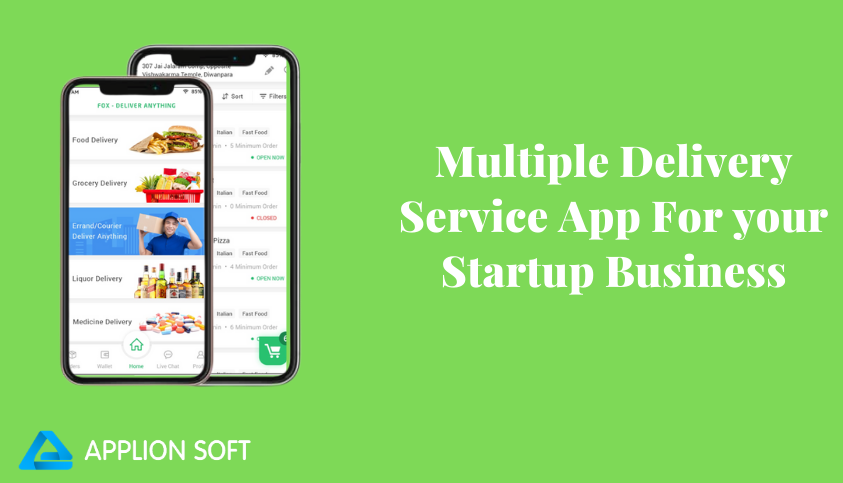
The delivery economy has moved past single-purpose apps. Customers no longer want to download five different apps for food, groceries, medicines, and parcels. They want one app that handles everything. This shift is exactly why a Multiple Delivery Service App has become one of the most searched and most funded business models in the on-demand space today.
If you are planning to enter this market, a Multiple Delivery Service App gives you the fastest path to build a brand that customers actually keep on their home screen. Instead of competing in one narrow category, you get to operate across food, grocery, pharmacy, courier, and specialty deliveries under a single platform, a single brand, and a single technology stack.
In this guide, we will walk through what a multi-service delivery platform actually is, why it works so well for new and existing businesses, the features it needs to succeed, how the launch process works, the challenges to plan for, and the revenue models that make it profitable. Whether you are an entrepreneur exploring your first venture or an established delivery business looking to expand beyond one category, this guide is written to give you a clear, practical roadmap you can act on right away.
What Is a Multiple Delivery Service App?
Put simply, it is a single mobile and web platform that lets customers order and receive several types of deliveries — food, groceries, medicines, flowers, documents, courier parcels, and more — from one unified interface. Instead of building and maintaining separate apps for each vertical, businesses run everything through one ecosystem with shared users, shared delivery partners, and shared backend infrastructure.
This is a meaningful departure from how most delivery businesses were built a decade ago. Back then, a food delivery startup stayed focused on food, and a courier company stayed focused on parcels. Today, the lines between these categories have blurred, and customers expect one dependable app to handle whatever they need delivered, whenever they need it.
Think of it as combining the convenience of a food delivery app, the reach of a grocery delivery app, and the flexibility of a courier service into one experience. A customer opens the app, chooses the category they need, and completes the order the same way every time, regardless of what is being delivered. This is often described as a “delivery anything” model, because the platform is built to handle nearly any delivery request rather than being locked into one niche.
For entrepreneurs, this approach solves a real business problem: customer acquisition cost. Getting a person to install and trust a new app is expensive. A platform that solves multiple needs justifies that download and keeps people coming back far more often than a single-category app ever could.

Why Businesses Are Moving Toward a Multi-Service Delivery Platform
The on-demand delivery market has matured quickly, and customer expectations have matured with it. A few clear trends explain why so many entrepreneurs and existing businesses are now choosing an on demand delivery app clone built around multiple services instead of a single-purpose app.
1. Customers want fewer apps, not more
Smartphone users are increasingly selective about what stays on their home screen. A platform that covers food, grocery, pharmacy, and parcel delivery reduces app fatigue and increases the odds that customers actually open it regularly.
2. Higher order frequency
A pure food delivery app might see a customer order twice a week. A multi-category platform captures food orders, weekly grocery runs, occasional pharmacy needs, and courier requests from the same user, multiplying the number of touchpoints and transactions.
3. Stronger unit economics for delivery partners
When a delivery partner can accept a food order in the morning and a grocery or courier order in the afternoon, their earning potential improves. Better earning potential means better retention of delivery staff, which directly improves service reliability.
4. Lower cost of scaling into new categories
Once the core technology, delivery partner network, and customer base exist, adding a new delivery category is far cheaper than launching a brand-new app and marketing it from scratch.
5. Investor and market interest
Multi-service and super-app models have attracted significant attention globally because they demonstrate stronger lifetime value per customer compared to single-vertical platforms.
6. Built-in resilience during slow seasons
A single-category app can suffer badly when demand for that one category dips, whether due to seasonality, weather, or competition. A platform spread across several delivery types is far less exposed to a slowdown in any one segment, since other categories continue generating orders and revenue.
These factors combine to make a multi-service delivery business a more resilient and more scalable model than betting everything on one delivery category. Businesses that recognize this shift early tend to build a stronger competitive position before the market becomes crowded.
Key Features of a Multiple Delivery Service App
A successful multi-service delivery platform is really four connected applications working together: a customer app, a delivery partner app, a vendor or store app, and an admin panel. Each one needs to be built with the right features to keep operations smooth.
Customer App Features
- Multi-category browsing: Customers can switch between food, grocery, pharmacy, courier, and other categories from one home screen.
- Real-time order tracking: Live GPS tracking shows exactly where the delivery partner is and how long the order will take.
- Multiple payment options: Cash on delivery, cards, UPI, and in-app wallet support give customers flexibility at checkout.
- Scheduled deliveries: Customers can book a delivery slot in advance instead of ordering only for immediate dispatch.
- Order history and reordering: Quick access to past orders makes repeat purchases effortless.
- Ratings and reviews: Feedback on vendors and delivery partners builds trust and helps maintain service quality.
- In-app chat and support: Direct communication between customers, delivery partners, and support teams reduces order issues.
Delivery Partner App Features
- Smart order assignment: Delivery partners receive requests based on their location, availability, and current workload.
- Route optimization: Built-in navigation helps partners choose the fastest route, reducing delivery time.
- Earnings dashboard: Daily, weekly, and monthly earning reports keep delivery partners informed and motivated.
- Flexible availability toggle: Partners can switch their status online or offline with a single tap.
- Multi-order handling: Partners can accept and manage more than one delivery type in a single shift.
Vendor and Store App Features
- Inventory and catalog management: Store owners and restaurant partners can add, edit, or remove listings instantly.
- Order acceptance controls: Vendors can accept or reject incoming orders based on stock or capacity.
- Promotions and discount tools: Vendors can run offers directly through the app to attract more customers.
- Sales analytics: Reports on order volume, peak hours, and revenue help vendors make better decisions.
Admin Panel Features
- Centralized dashboard: A single view of all categories, orders, vendors, and delivery partners across the platform.
- Commission and payout management: Automated calculation of vendor payouts, delivery partner earnings, and platform commission.
- Zone and pricing configuration: Admins can set delivery zones, surge pricing, and category-specific rules.
- Reporting and analytics: Business-wide insights on growth, retention, and category-level performance.
Together, these features are what turn a simple delivery concept into a dependable, scalable platform that customers, vendors, and delivery partners can all rely on.
Why Choose Applionsoft for Your Multiple Delivery Service App
Building a multi-service delivery platform from scratch typically takes several months and a sizable development budget. Applionsoft removes that barrier with a ready-to-deploy, fully customizable on demand delivery app clone that businesses can launch in a matter of days instead of months.
Here is what sets Applionsoft apart:
- Ready-made yet fully customizable: The platform comes pre-built with all core modules, and every feature, workflow, and design element can be tailored to match your brand and business model.
- Faster time to market: Because the foundation is already built and tested, you avoid the long development cycles associated with building an app from the ground up.
- Android and iOS coverage: Applionsoft delivers native apps for both platforms, along with a responsive admin dashboard, so you reach customers wherever they are.
- Scalable architecture: The platform is built to handle growing order volumes, additional cities, and new delivery categories as your business expands.
- Multi-language and multi-currency support: Whether you are launching locally or planning to expand internationally, the app is ready to support diverse markets from day one.
- End-to-end support: From consultation and customization to deployment and post-launch maintenance, Applionsoft supports the entire journey, not just the initial build.
- Proven “delivery anything” framework: The platform architecture is designed around a delivery anything approach, meaning new categories such as flowers, documents, or specialty items can be added without rebuilding the app.
For entrepreneurs who want to move fast without compromising on quality, an on demand delivery app clone from an experienced provider is often the more practical route compared to starting a custom build from zero.
Challenges to Plan For
A multi-service delivery business is rewarding, but it does come with a few operational challenges worth planning for in advance.
Coordinating multiple vendor types:
Restaurants, grocery stores, and pharmacies each have different stock cycles, packaging needs, and order preparation times. Your onboarding and vendor-management process should account for these differences from the start.
Managing a shared delivery fleet:
Assigning the right order to the right delivery partner, especially when different categories require different handling, needs a smart and well-tuned dispatch system.
Maintaining service quality across categories:
It is easier to maintain a consistent customer experience when you are managing one category. Expanding into several requires stronger quality checks, clear SLAs with vendors, and continuous monitoring through the admin panel.
Balancing marketing across categories:
Promoting five delivery categories at once can spread your marketing budget thin. Many successful businesses lead with one strong category and use it to introduce customers to the rest of the platform.
None of these challenges are unusual or difficult to manage, but recognizing them early helps you build the right processes before they become bottlenecks.
How to Launch Your Multiple Delivery Service App
Launching a multi-service delivery platform does not need to be complicated if you follow a structured process. Here is a practical roadmap:
Define your core categories
Decide which delivery types you will launch with first, such as food and grocery, and which categories you will add later. Trying to launch every category at once can dilute focus and quality.
Choose your technology approach
You can build from scratch, which takes months and significant investment, or choose a ready-made solution that can be customized and launched much faster.
Customize the branding and workflows
Update the app with your business name, logo, color scheme, and any category-specific workflows your market requires.
Onboard vendors and delivery partners
Before launch, build a base of restaurants, stores, pharmacies, or other vendors, along with a reliable pool of delivery partners in your target zones.
Set up pricing and commission structures
Configure delivery fees, service charges, surge pricing rules, and commission percentages for each category.
Test thoroughly across all four apps
Run test orders across the customer app, delivery partner app, vendor app, and admin panel to catch issues before going live.
Launch and market locally first
Focus marketing efforts on one city or region initially, build a strong reputation and reliable delivery network, then expand into new areas.
Monitor, iterate, and expand categories
Use admin panel analytics to identify what is working and gradually introduce new delivery categories based on demand.
Following this sequence reduces risk and helps you build a stable operation before scaling aggressively.
Revenue Models for a Multi-Service Delivery Platform
One of the biggest advantages of a multi-service platform is the number of ways it can generate revenue. Common models include:
Delivery fees:
A charge applied to every order based on distance, category, or order value.
Commission from vendors:
A percentage cut from every sale made through the platform by restaurants, stores, or pharmacies.
Subscription plans:
Premium memberships offering free or discounted delivery for frequent customers.
Surge pricing:
Higher delivery charges during peak hours or high-demand periods.
Advertising and featured listings:
Vendors pay to be highlighted in search results or category pages.
Service fees:
Small platform charges applied at checkout in addition to delivery fees.
Because such a platform operates across several categories, these revenue streams stack rather than compete with each other, which generally leads to stronger overall margins compared to a single-category app. Over time, as order volumes grow and more vendors join the platform, these combined streams also make it easier to reinvest in marketing, delivery partner incentives, and new category expansion.
Conclusion
The shift toward multi-service platforms is not a passing trend. It reflects a genuine change in how customers want to interact with delivery businesses: fewer apps, more convenience, and one trusted brand for everything they need delivered. A well-built Multiple Delivery Service App puts your business at the center of that shift, giving you multiple revenue streams, higher customer retention, and a scalable foundation for growth.
If you are ready to launch, partnering with an experienced clone app development company can save you months of development time and help you avoid common pitfalls. Applionsoft brings the technology, the customization, and the ongoing support needed to take your idea from concept to a fully functioning platform, ready to serve customers across every delivery category you choose to offer.
