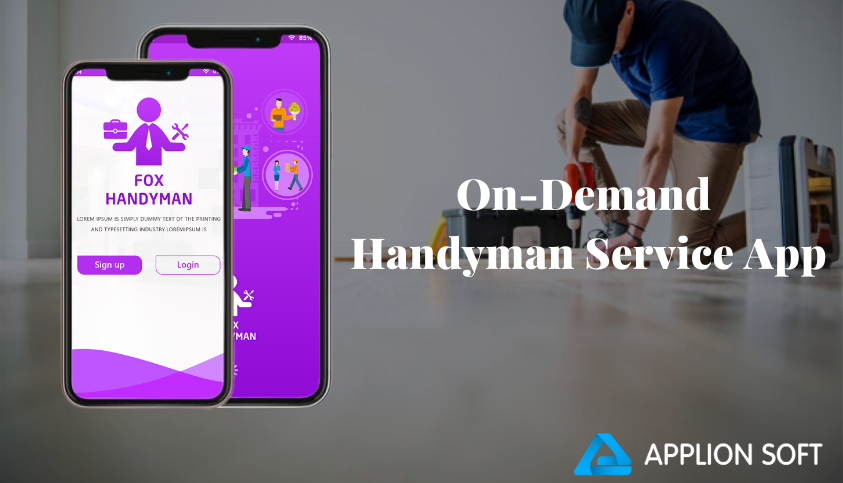
Home repairs never wait for a convenient time. A leaking tap, a broken switchboard, or a squeaky door hinge always shows up when you have zero time to deal with it. This is exactly why people now open an app instead of flipping through a local directory to find help. An On-Demand Handyman Service app puts skilled professionals just a few taps away, and this shift in customer behavior has turned into a serious business opportunity for startups worldwide.
If you are exploring ways to enter the home services industry, this is the right moment. The market is growing fast, customer habits have already changed, and the technology to build a reliable platform is more accessible than ever. In this guide, we will walk you through everything you need to know about launching an On-Demand Handyman App, from the business model and must-have features to costs and revenue streams.
What Is an On-Demand Handyman Service App?
An On-Demand Handyman Service app is a digital platform that connects customers who need home repair or maintenance work with verified, skilled professionals nearby. Think of it as a marketplace where a customer can book a plumber, electrician, carpenter, painter, or appliance technician in a few minutes, track their arrival, and pay online once the job is done.
This is often called an Uber for Handyman solution because it borrows the same core idea that made ride-hailing apps successful: match supply with demand in real time, keep the process transparent, and remove the friction of phone calls, price haggling, and waiting around. A customer opens the app, selects a service, picks a time slot, and a nearby handyman accepts the job. No middlemen, no guesswork, and no long waiting periods.
For a startup, this model is attractive because it does not require you to own tools, hire a full-time repair crew, or manage inventory. You build and manage the platform, while independent professionals fulfill the actual jobs. This is precisely why so many entrepreneurs are now searching for a handyman clone app solution instead of building something from scratch.
Why the On-Demand Handyman Service Market Is Booming
The home services industry is not a small or shrinking market. Independent market research firms report the global handyman services market crossing several hundred million dollars in value, with multiple reports projecting double-digit annual growth through the early 2030s as urban households increasingly turn to app-based booking instead of word-of-mouth referrals. A few forces are driving this growth:
- Busy urban lifestyles: Working professionals simply do not have time to find, call, and negotiate with a local handyman.
- Aging housing stock: Older homes need frequent plumbing, electrical, and structural repairs, creating steady, recurring demand.
- Rising trust in gig-economy platforms: After years of using apps for cabs, food, and groceries, customers are comfortable booking home services the same way.
- Growing rental and real estate markets: Landlords and property managers need fast, reliable repair services for their properties.
- Preference for verified professionals: Customers want background-checked, rated, and insured workers rather than an unknown contractor from a classified ad.
Online booking already accounts for a majority share of how customers access handyman services in many regions, and that share keeps climbing every year. This is the clearest signal that now is the right time to launch an On-Demand Handyman Service, before the market gets even more crowded.
Why Startups Should Build an On-Demand Handyman App Now
Timing matters in any business, and the home services space is at an inflection point. Here is why building this kind of platform makes sense for a startup today rather than later.
1. Low entry barrier compared to other on-demand industries
Unlike food delivery or ride-hailing, you do not need cold storage, delivery fleets, or vehicle fleets. Your biggest investment is the technology platform and your professional network.
2. Asset-light business model
You are building a marketplace, not a repair company. Handymen bring their own tools and expertise; you provide the booking engine, payment system, and trust layer.
3. Recurring revenue potential
Home maintenance is not a one-time need. Once a customer has a good experience, they come back for the next repair, and many platforms successfully upsell annual maintenance plans.
4. Multiple monetization streams
From commission on every booking to subscription plans, service fees, and featured listings for top-rated professionals, this kind of app opens several income channels at once.
5. Faster time-to-market with a clone app
You do not have to reinvent the wheel. A handyman app like Uber can be built on a proven, ready-made framework and customized with your branding, service categories, and pricing logic, cutting development time from many months down to a few weeks.
How an On-Demand Handyman App Works
Before you invest in development, it helps to understand the basic workflow. A typical handyman booking platform has three connected apps working together.
Step 1: Customer places a request
The customer opens the app, selects the type of service needed (plumbing, electrical, carpentry, cleaning, painting, appliance repair, and so on), describes the issue, uploads photos if needed, and picks a preferred time slot.
Step 2: The system matches a professional
The platform’s backend finds the nearest available and qualified handyman based on service category, ratings, and current location, then sends the job request.
Step 3: The handyman accepts and travels to the location
Once accepted, the customer can track the professional’s arrival in real time, just like tracking a cab.
Step 4: The job gets done and payment is processed
After the work is completed, the customer confirms the job, pays through the app using their preferred method, and rates the experience.
Step 5: Feedback closes the loop
Ratings and reviews help maintain quality across the platform and guide future customers toward the best-rated professionals.
This simple, transparent cycle is exactly what makes an Uber for Handyman model so appealing to today’s customers, who value speed and clarity over anything else.
Must-Have Features of a Handyman Clone App
A successful handyman clone app needs three separate interfaces working in sync: one for customers, one for service professionals, and one for the admin who runs the platform.
Customer App Features
- Easy sign-up and login: Social login, email, or mobile OTP for quick onboarding.
- Service categories: A clean list of services such as plumbing, electrical, carpentry, painting, appliance repair, cleaning, and pest control.
- Real-time booking and scheduling: Book instantly or schedule for a later date and time.
- Live tracking: Track the assigned handyman’s location on a map.
- In-app chat and calling: Communicate directly without sharing personal phone numbers.
- Multiple payment options: Cards, wallets, UPI, and cash-on-completion.
- Transparent pricing: Upfront estimates before confirming a booking.
- Ratings and reviews: Build trust through verified customer feedback.
- Booking history: Easy access to past jobs, invoices, and receipts.
- Push notifications: Updates on booking status, arrival time, and offers.
Handyman (Service Provider) App Features
- Simple onboarding with document verification: ID proof, skill certification, and background checks.
- Availability toggle: Professionals can go online or offline based on their schedule.
- Job request alerts: Instant notifications for nearby job opportunities.
- Navigation support: Built-in maps to reach the customer’s location.
- Earnings dashboard: Daily, weekly, and monthly income tracking.
- In-app wallet: Track payouts and withdraw earnings easily.
- Job history and ratings: A transparent record of completed work and customer feedback.
Admin Panel Features
- Centralized dashboard: Monitor bookings, active professionals, and revenue in real time.
- User and provider management: Approve, verify, suspend, or manage accounts.
- Service and category management: Add, edit, or remove services and pricing.
- Commission and payout management: Set commission rules and manage settlements.
- Analytics and reporting: Track platform performance, demand trends, and top-performing regions.
- Promotions and coupon management: Run campaigns to boost bookings during low-demand periods.
- Dispute resolution tools: Handle cancellations, refunds, and customer complaints efficiently.
Together, these features turn a simple booking tool into a complete service ecosystem that can scale with your business.
Uber for Handyman: Why This Business Model Works
The phrase Uber for Handyman has become shorthand for any platform that applies ride-hailing logic to home services, and there is a good reason this comparison sticks. Uber succeeded by solving three problems at once: discovery (finding a driver fast), trust (ratings and verified profiles), and payment (cashless, automatic, and transparent). A handyman app like Uber solves the exact same three problems for home repairs.
Before these apps existed, finding a reliable handyman meant asking neighbors, scrolling through classified listings, or calling multiple numbers and hoping someone picked up. There was no way to verify skills, no fixed pricing, and no accountability if the job went wrong. An app-based marketplace fixes every one of these pain points, which is exactly why customers have shifted so quickly toward digital booking for home services.
For a startup, replicating this proven model through your own platform means you are not experimenting with an unproven concept. You are applying a business model that has already worked at scale in adjacent industries, tailored specifically to the home services niche.
Revenue Models for Your On-Demand Handyman App
A well-designed on-demand handyman platform can generate income in more than one way. Most successful platforms combine two or three of the following:
1. Commission per booking:
A percentage cut from every job completed through the platform, typically the primary revenue source.
2. Subscription plans for professionals:
Handymen pay a monthly or annual fee for premium visibility, more job requests, or reduced commission rates.
3. Customer membership plans:
Offer priority booking, discounted rates, or free inspections for a recurring subscription fee.
4. Service fees:
A small convenience or booking fee charged to the customer on top of the service cost.
5. Featured listings and advertising:
Charge top-rated professionals for premium placement in search results.
6. Cancellation fees:
A small charge for last-minute cancellations to protect professionals’ time.
Choosing the right mix depends on your target market, competition, and how price-sensitive your early customers are.
Key Challenges and How to Solve Them
Every on-demand business faces a few common hurdles, and the handyman niche is no exception.
Challenge 1: Trust and safety
Customers are letting strangers into their homes, so trust is non-negotiable.
Solution: Mandatory background verification, skill certification, in-app tracking, and a strong ratings system.
Challenge 2: Supply-demand balance
Not enough professionals during peak hours leads to poor customer experience.
Solution: Smart demand forecasting, surge incentives for professionals during busy periods, and flexible onboarding to grow your provider base quickly.
Challenge 3: Quality consistency
Service quality can vary widely between individual professionals.
Solution: Standardized checklists, mandatory photo proof of completed work, and a review-based ranking system.
Challenge 4: Customer retention
One-time users are easy to acquire but hard to retain.
Solution: Loyalty programs, maintenance reminders, and personalized offers based on past bookings.
Addressing these challenges early, right from the platform design stage, gives your business a much stronger foundation than competitors who fix problems only after they surface.
How to Choose the Right Development Partner
Not every technology partner understands the nuances of the home services industry. When evaluating a company to build your handyman app like Uber, look for these qualities:
- Proven experience with on-demand and clone app development, not just generic app-building experience.
- A ready-made, customizable framework that shortens your time to launch.
- Strong focus on scalability, so the platform can handle growth without a rebuild.
- Transparent pricing and clear project timelines.
- Post-launch support, including updates, bug fixes, and feature additions as your business grows.
A development partner who has already built similar platforms will help you avoid common mistakes and get your app to market faster.
Cost to Build an On-Demand Handyman Service App
The cost of building this type of app depends on several factors: the number of features, the platforms you target (Android, iOS, or both), design complexity, and whether you choose custom development or a clone app solution.
Building a platform completely from scratch, with custom UI/UX, backend architecture, and testing across every device, takes significantly longer and costs more. A ready-made clone solution, on the other hand, is built on a tested, pre-structured framework. It already includes the core booking, tracking, and payment logic, so your development team only needs to customize branding, service categories, and specific business rules. This approach typically cuts both cost and development time dramatically compared to building everything from the ground up.
For an accurate estimate tailored to your specific requirements, it is best to share your feature list and target market with a development team and request a detailed quote.
Why Choose Applionsoft for Your Handyman Clone App
Applionsoft specializes in building on-demand and clone app solutions for startups across industries, including ride-hailing, food delivery, grocery delivery, and home services. Our team understands what it takes to launch a reliable On-Demand Handyman Service app that customers trust and professionals want to work with.
We offer a ready-to-launch clone framework that is fully customizable, so you get a platform built around your brand, your service categories, and your target market, without waiting months for development. From the customer app and provider app to the admin dashboard, every part of the platform is designed for real-world scalability.
As a clone app development company, Applionsoft has helped startups across the on-demand economy move from idea to a working platform quickly and affordably. If you are ready to launch your own On-Demand Handyman App, our team can guide you from concept to a fully functional product.
Conclusion
The home services industry is shifting online, and customers now expect the same convenience from a handyman booking that they get from ordering food or booking a cab. Startups that move now, with a well-built home services app, have a real opportunity to capture this growing market before it becomes saturated.
Whether you choose to build from scratch or launch faster with a clone solution, the important thing is to start with a platform that customers can trust and professionals want to use. With the right features, the right revenue model, and the right clone app development partner, your On-Demand Handyman App can become the go-to solution in your target market.