
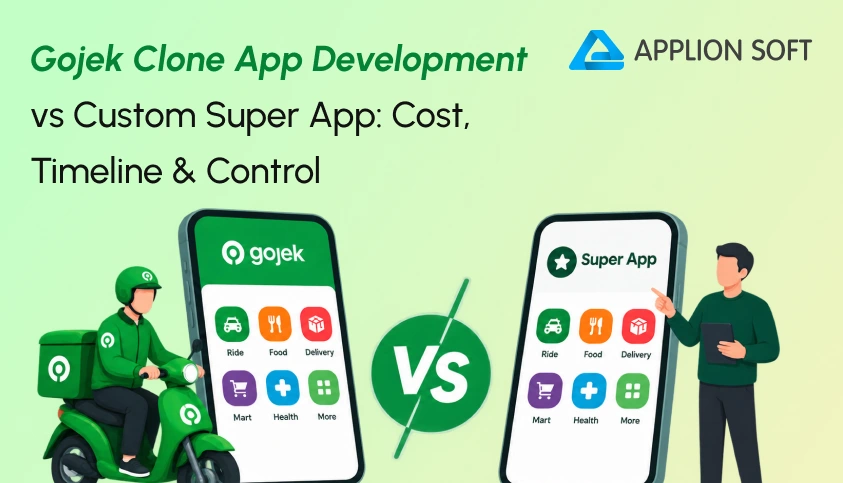
Choose Gojek clone app development if you want to launch a multi-service app in 4 to 10 weeks, spend roughly $10,000 to $40,000 and brand a proven feature set as your own. Choose a custom super app if your service idea is truly new, you have $150,000 or more and you can wait 9 to 18 months. Many smart founders do both: they launch on a clone first, then build custom modules where they need to stand apart.
Every founder who studies Gojek asks the same question sooner or later. Should I buy a ready-made platform, or build my own from scratch? The answer shapes your budget, your launch date, and how much of the product you truly own.
This guide compares Gojek clone app development with a custom super app on the three things that matter most: cost, timeline, and control. We use plain numbers, honest trade-offs, and a simple decision framework. By the end, you will know which path fits your market, your money, and your growth plan.
What Is the Real Difference Between a Clone and a Custom Super App?
A Gojek clone is a pre-built, tested platform that follows the structure of Gojek. It usually includes a customer app, a service provider app, a merchant panel, and an admin dashboard. You add your logo, pick your services and launch. A good Gojek app clone ships with ride booking, food delivery, parcel delivery, home services, and a digital wallet.
A custom super app starts from a blank page. Your team or agency designs every screen, writes every API, and chooses every technology. Nothing exists until someone builds it.
Think of it like buying a house versus building one. The ready-made home gets you in this month. The custom home fits you perfectly, but you wait longer and pay more.
Neither path wins in every case. The right choice depends on how different your idea is from what Gojek already does.
How Does the Gojek Business Model Shape Your Build Choice?
Before you pick a path, look closely at what you are copying. The Gojek business model works because one app serves three groups at once: customers, service providers, and merchants.
Gojek began in Indonesia as a call center for motorcycle taxis. It launched its app in 2015 with four services: GoRide, GoSend, GoShop, and GoFood. Over time, it grew into a super app with more than 20 services. In 2021, it merged with Tokopedia to form GoTo.
Gojek earns money in several ways:
- Commissions on every ride, order, and booking
- Delivery and service fees paid by customers
- Advertising from merchants who want more visibility
- Payment income from its GoPay wallet
Study the Gojek business model before you write any brief, because it tells you which features earn money. Why does this matter for your decision? A clone gives you this revenue structure on day one. Commissions, wallet, and ad slots are already wired in.
A custom build lets you design a different model, such as a subscription-first or business-to-business platform. If your plan is the same model in a new city, a clone is usually enough. If your plan is a new model, custom may be worth the extra cost.
Which Core Features Do Both Paths Need?
Whichever path you pick, a Gojek-style platform needs the same core. A typical gojek app clone ships with these parts on day one. A custom build must create every one of them:
- A multi-service home screen where users pick rides, food, parcels, or home services
- Live order tracking with maps and driver location
- A digital wallet, card payments, and cash on delivery
- Provider onboarding with document checks and approval
- A merchant dashboard for menus, prices, and orders
- An admin panel for commissions, promo codes, and reports
- Ratings, in-app chat, and push notifications
With a gojek app clone, these modules are already tested. With super app development from scratch, each module adds weeks of design, coding, and testing. That gap explains most of the cost and time difference in the next two sections.
Cost Comparison: What Will Each Path Really Cost?
Prices for gojek like app development vary by vendor, region, and scope. Your final cost also depends on how closely your plan follows the Gojek business model. The ranges below are typical market estimates, not fixed quotes.
Use them to set expectations before you ask for proposals.
| Cost Item | Gojek Clone | Custom Super App |
|---|---|---|
| Core build (customer, provider, merchant apps + admin) | $10,000 to $40,000 | $150,000 to $500,000+ |
| Branding and UI changes | Often included | $15,000 to $50,000 |
| Each extra service module | $1,000 to $5,000 | $10,000 to $40,000 |
| Monthly cloud, maps, SMS, payment fees | $500 to $3,000 | $1,500 to $10,000+ |
| Yearly maintenance | 15% to 20% of build | 15% to 25% of build |
| Typical first-year total | $15,000 to $60,000 | $200,000 to $700,000 |
Why a Clone Costs Less
The product already exists. You pay for licensing, branding, setup, and the changes you request. The vendor spreads its research, design, and testing cost across many clients. That is why Gojek clone app development costs a fraction of a new build.
Why Custom Costs More (and Drifts)
A custom team must run discovery, design, development, testing, and DevOps. You also need a product manager, a designer, and several engineers. Scope tends to grow as new ideas appear, so budgets drift upward. Many teams spend 20% to 30% above their first estimate.
Hidden Costs to Plan For
Both paths carry costs that rarely appear in a first quote:
- Map, SMS, and payment gateway fees that grow with your order volume
- App store developer accounts and policy updates
- Driver and merchant onboarding, plus support staff
- Marketing spend to win your first 1,000 users
- Legal setup, such as terms of service, privacy policy, and local licenses
Ask every vendor three questions. What is included in the price? What costs extra? What happens to my fees when my order volume doubles?
Timeline Comparison: How Fast Can You Launch?
Speed is often the deciding factor. Here is how a typical project unfolds on each path.
| Phase | Gojek Clone | Custom Super App |
|---|---|---|
| Discovery and planning | 1 week | 4 to 8 weeks |
| Design | 1 to 2 weeks (branding only) | 6 to 10 weeks |
| Development | 2 to 6 weeks (customization) | 6 to 12 months |
| Testing and fixes | 1 to 2 weeks | 6 to 10 weeks |
| Store approval | About 1 week | 1 to 2 weeks |
| Total | 4 to 10 weeks | 9 to 18 months |
Why does speed matter so much? Because a launched app teaches you more than a planned one. Gojek clone app development lets you collect real orders, real driver feedback, and real payment data while a custom team is still writing its first sprint.
Speed also protects your market window. If a competitor enters your city six months before you, you may lose the best drivers and merchants. Early supply is hard to win back.
There is one more benefit. A short timeline lowers your risk. If the market is weaker than you expected, you can pivot after spending $30,000 instead of $300,000.
Control Comparison: Who Owns What?
Cost and time are easy to measure. Control is harder, and it often matters most after year one.
| Area | Gojek Clone | Custom Super App |
|---|---|---|
| Source code | Depends on license | Full ownership |
| Feature roadmap | Shared base, custom add-ons possible | Entirely yours |
| Technology choice | Vendor’s stack | Your choice |
| Branding | Full, with a white-label setup | Full |
| Data and integrations | Yours, within the architecture | Yours |
| Scaling limits | Strong for early and mid stage | Built for your target scale |
| Vendor dependence | Medium | Low, but team dependence is high |
What a White-Label Setup Really Means
A white-label Gojek clone app removes the vendor’s brand and puts yours in its place. You get your own logo, colors, domain, and app store listing. Customers never see the vendor’s name.
Even a white-label Gojek clone app does not always come with the code. Ask which license you are buying:
- Subscription license: You rent the platform and pay monthly. It costs less upfront, but you depend on the vendor.
- Source code license: You receive the code with some usage limits.
- Full source ownership: You own the code and can change it freely.
The Control Trade-Off in Plain Words
With a clone, you control the brand, the services, the pricing, and the business rules. You share control of the core architecture. With a custom build, you control everything, but you also carry everything: bugs, hiring, upgrades, and security.
Control has a price. Ask yourself whether you need it today or only think you might need it later.
When Should You Choose Each Path?
Use this checklist to decide quickly.
Choose a Gojek clone if:
- You want to test a market before investing heavily
- Your services match common ones: rides, food, grocery, parcels, home services
- Your budget is under $60,000 for the first year
- You need to launch within three months
- You do not have an in-house tech team
Choose a custom super app if:
- Your core service does not exist in any ready-made platform
- You have strict compliance or security rules, such as banking-grade requirements
- You have funding of $200,000 or more and a team to manage the project
- Your long-term value comes from proprietary technology
- You can wait a year or more before earning revenue
If you checked boxes on both lists, read the next section. The hybrid path may be your best answer.
Three Founder Scenarios: Which Path Fits?
Numbers help, but stories make them real. Here are three common situations.
Scenario 1: The city launcher. Maya wants food and parcel delivery in one mid-size city with $35,000. She picks a white-label Gojek clone app, brands it, and goes live in eight weeks. She spends the rest of her budget on driver incentives and local marketing.
Scenario 2: The enterprise builder. A regional telecom with two million subscribers wants banking, loyalty, and mobility in one app. Its security and data rules are strict. It chooses custom super app development, hires a product team, and accepts a 14-month timeline.
Scenario 3: The home-services founder. Arjun runs a plumbing and cleaning business. He starts with gojek like app development to launch booking and payments fast. After four months, he adds a custom subscription plan for repeat customers because his data shows they order monthly.
Notice the pattern. Maya and Arjun let real demand guide their spending. The telecom had a clear reason to build everything itself.
The Hybrid Path: Launch on a Clone, Then Customize
The hybrid path is simple and, for many startups, the smartest. Here is how it works:
- Launch fast. Treat a gojek app clone as version one, not the final product. Use Gojek clone app development to go live in under 10 weeks with your own brand.
- Learn for 90 days. Track orders, repeat rate, driver supply, and cancellation reasons.
- Find your edge. Pick the one or two features that customers love most or ask for most. Check each idea against your Gojek business model: does it raise orders, margin, or repeat use?
- Build only those parts custom. Add them as new modules or connect them through APIs.
- Rebuild the core only if scale demands it. Many apps never need this step.
Because a white-label Gojek clone app carries your own brand, customers never notice where you started. This approach keeps your first-year cost low and your risk small. It also gives you real data to guide every custom decision. Instead of guessing what users want, you build from proof.
Teams that choose a gojek-like app development route as a starting point often find that 70% to 80% of their needs are already covered. The remaining 20% to 30% is where custom work creates real value.
Five Mistakes Founders Make When Choosing
1. Chasing 50 services at launch. More services do not mean more users. Start with two or three, and prove demand.
2. Comparing only the upfront price. A cheap quote with no support plan can cost more within a year.
3. Skipping the license check. Always confirm code ownership, update rights, and what happens if the vendor closes.
4. Treating custom as “better”. Custom super app development is only better when your idea needs it. Otherwise, it just delays your revenue.
5. Ignoring the supply side. Drivers, merchants, and providers decide whether your app lives. Plan their onboarding, payouts, and support before you plan features.
How to Choose the Right Development Partner
Whichever path you pick, the partner matters as much as the product. For gojek like app development in particular, a weak partner can turn a six-week launch into a six-month delay. Use this short checklist:
- Live demos: Test the customer, provider, and admin apps yourself.
- Real references: Speak with at least two clients who launched.
- Clear scope: Get a written list of features, modules, and exclusions. Confirm that a white-label Gojek clone app includes store publishing help.
- Support terms: Confirm bug fixes, updates, and response times in writing.
- Scalability proof: Ask how the platform handles 10,000 or more daily orders.
- Security basics: Check data encryption, role-based access, and payment compliance.
If you want to see what Gojek clone app development looks like in practice, explore the Gojek clone app from Applionsoft and test the demo against this checklist.
Conclusion: Pick the Path That Fits Your Stage
The choice is not clone versus custom forever. It is about what you need right now. If you want speed, low cost, and a proven structure, Gojek clone app development gets you to market first. If you need unique technology and full control, a custom build is worth the wait and the budget.
For most startups, the best plan is to launch lean, learn fast, and invest in custom features only after real users prove they matter. Start by shortlisting a trusted clone app development company, compare its demo with your must-have features, and decide with data instead of guesses.